



4 Kimp Alternatives for Small Business Content
SUMMARY
Compare ManyPixels, Stillmore, Penji and Flocksy with Kimp by price, scope and owner workload. See which service fits recurring graphics, photo-based social content or a mixed creative queue.
Maya Brooks
Contents

I compared Kimp with four alternatives by checking the plan a small business would actually need. The differences were specific: Penji puts short-form video in a higher tier, ManyPixels publishes a daily-hour allowance, and Stillmore prices a smaller allowance of finished social content. Choosing between Kimp alternatives starts with those differences, before comparing the headline prices.
This article is published by the Stillmore team, and Stillmore is one of the options. My hands-on checks cover public pricing and service-selection pages on November 16, 2026. I did not commission paid projects from these providers, so this is a buying-flow comparison, not a test of finished work or delivery quality.
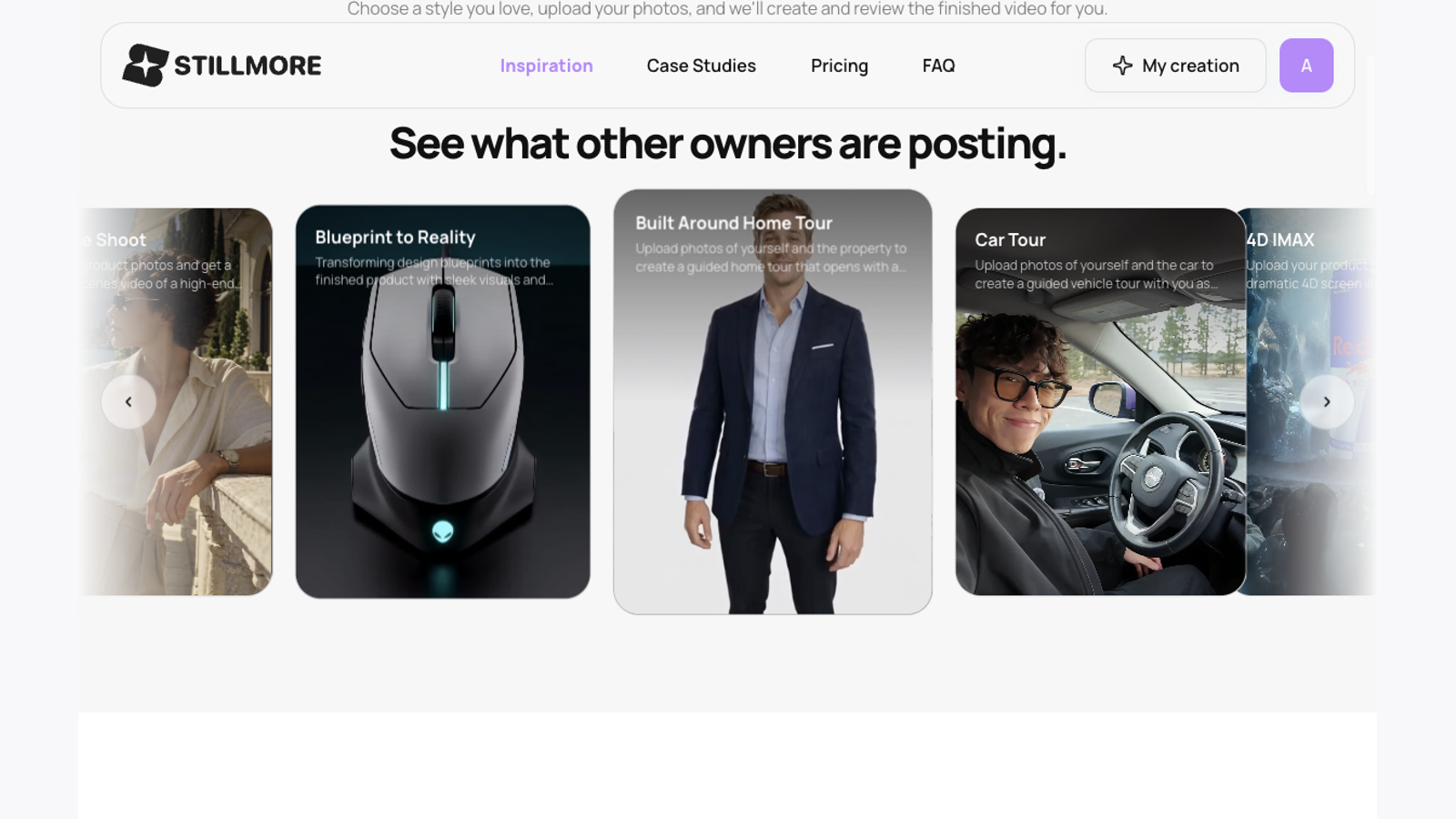
Public Stillmore Inspiration previews, captured November 16, 2026. These are examples available to browse, not work commissioned for this comparison.
What is Kimp?
Kimp sells Graphics, Video and Graphics + Video subscriptions. The graphics offering covers jobs such as print layouts, presentations and illustrations; the video offering adds editing and motion work. You choose the service that covers your requests, then keep a queue of jobs for the team and review the results. That range can suit a business whose design needs extend well beyond its social feed.
When I switched the public pricing page's service list from Graphics to Videos, it showed tasks including animating static designs, combining footage and making product-highlight videos. For a buyer with photographs, that opens a useful conversation about animating existing images. Its regular monthly rates are $1,397 for Graphics or Video and $1,697 for the combined subscription. The advertised 50% offer applies to the first four months; it should not become your permanent budget. Kimp remains worth considering when you need its broader range often enough to keep a production queue busy.
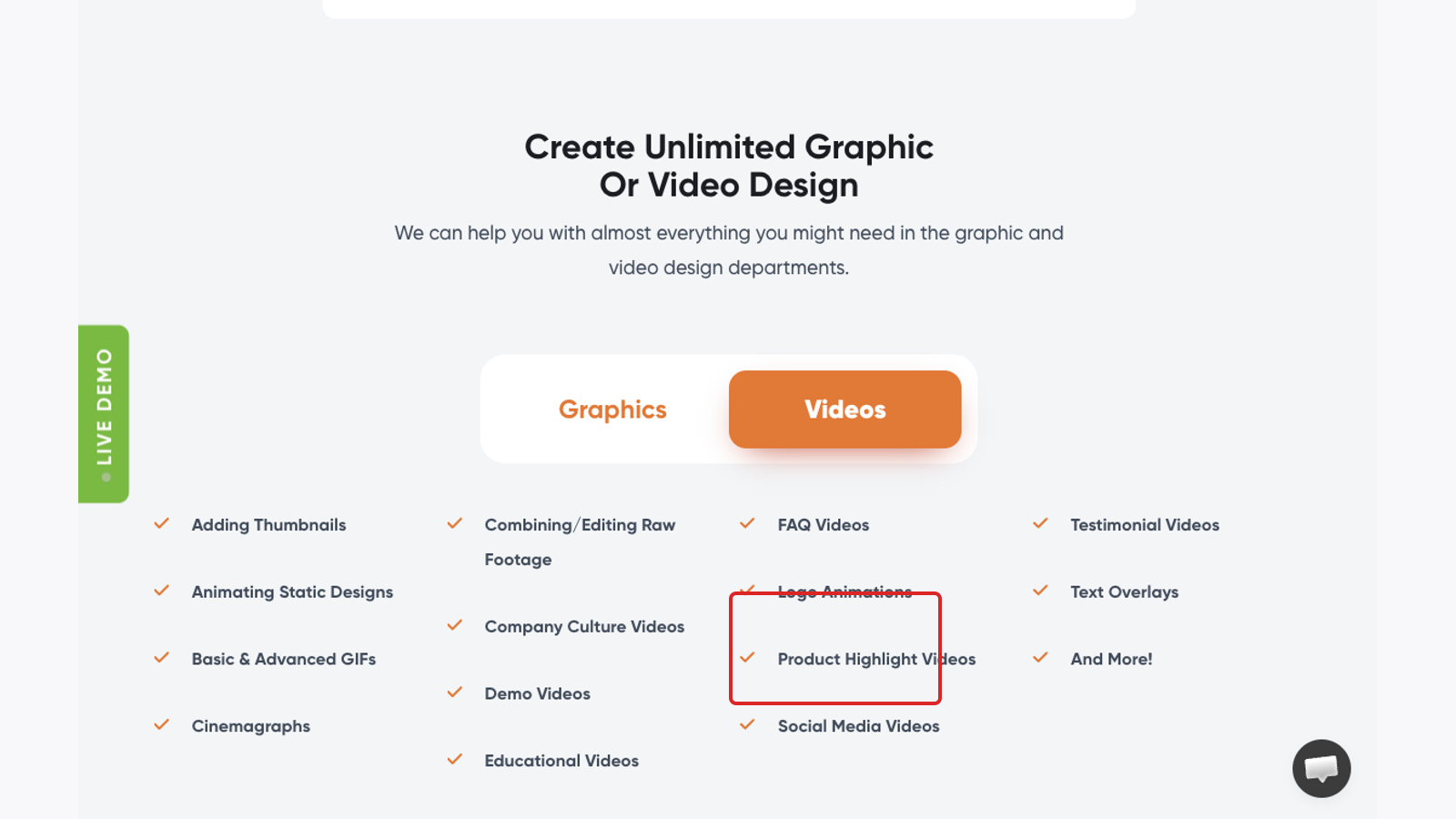
Kimp public Videos service selector, captured November 16, 2026. The red box marks Product Highlight Videos in the available service list.
The Kimp alternatives at a glance
Prices below are USD. Monthly rates are shown unless a different billing commitment is explicit. Published turnaround and capacity describe the offer; they are not delivery times measured in this comparison.
| Service | Best fit | Price relevant to this comparison | Published capacity or turnaround | Work you still manage |
|---|---|---|---|---|
| Kimp, baseline | Broad graphic and video requests | $1,397/month for Graphics or Video; $1,697 combined, before introductory discounts | Limited active production; simple designs advertised from 24 hours | Briefs, priorities, feedback and publishing |
| ManyPixels | Recurring graphics with a smaller entry budget | Advanced $699/month; $559/month equivalent on yearly billing | Up to 2 hours a day; next-day delivery advertised | What to request, the queue and approvals |
| Stillmore | Promotional images and videos from business photos | Try it $29/month; Growth $129 monthly or $99/month on annual billing, current founding offers | Try it: 1 video or 6 images/month; Growth: up to 6 videos or 36 images | Accurate photos and business details; final posting |
| Penji | Several ongoing design requests | Essentials $995/month; Agency Partner $1,995/month | 2 active projects on Essentials; 3 on Agency Partner | Briefing, feedback and priorities across projects |
| Flocksy | A mix of design, video and copy work | 2 Daily Hours $1,699 monthly or $1,199/month on annual billing | 2 creative hours per business day; unused hours bank for up to 30 days | A prioritized queue and timely approvals |
These prices buy different things. A monthly allowance of finished social pieces cannot be read as equivalent to two hours of design work each business day. Nor does a lower entry price tell you what a mixed campaign will cost once you need video, several formats and revisions.
How I tested
I used the public pages as a buyer deciding what to purchase, without placing an order. I checked the plan cards against their explanatory text, opened the available service details, and compared billing options where the page offered them. The screenshots show the decision points, not private project dashboards or work delivered to a client.
The test used three illustrative shopping needs: recurring graphics, promotional content made from an owner's photos, and a queue mixing graphics with video. Those are comparison scenarios, not projects I submitted. I recorded the stated limits and the responsibilities left with the customer. I did not time production, score visual quality, or compare how many revisions a real brief required.
For context, G2's graphic design services category distinguishes production subscriptions from services that also add creative direction and management. That distinction is more useful here than treating every provider as the same purchase. A design team can complete a clear list of jobs while still leaving the owner responsible for deciding what belongs on that list.
Four Kimp alternatives for different workloads
ManyPixels: Best for recurring graphic design
A retailer who already knows which graphics are needed has a practical reason to start with ManyPixels. Its Advanced plan is $699 on monthly billing, compared with Kimp Graphics' regular $1,397. This is a comparison of entry prices, not a claim that the two teams deliver the same volume or standard of work. The saving matters only if the lower plan covers the jobs you actually request. The pricing page lists no free tier.
I compared the Monthly and Yearly tabs: Advanced showed $699 with monthly billing and $559 per month with yearly billing. The daily allowance remained up to two hours. That is a useful distinction because the lower displayed monthly equivalent buys a longer commitment, rather than additional production capacity.
The current Advanced plan describes up to two hours of work a day and advertises next-day delivery. Business raises the published allocation to four hours for $1,199 a month. ManyPixels also sells Assigned Designer and Design Team plans for buyers who need closer day-to-day collaboration. Choose between them by the amount of work you can supply and how closely you need to work with an assigned designer.
For example, a shop could prepare a prioritized list containing a new price card, a promotion graphic and an email banner. These are hypothetical requests, but they expose an important buying question: does your business have someone who can supply the correct text and decide which job comes first? If it does, a recurring design service may fit well. If no one has time to choose next week's promotion, buying more design hours does not settle that decision.
Pros: The entry monthly price is below Kimp's regular graphics rate, and the published daily-hour allocation gives you a concrete capacity question to discuss before subscribing. A higher plan provides a way to add capacity when the queue justifies it.
Where it falls short: Two hours a day is a limit, even when requests and revisions are described as unlimited. A complicated layout and its revisions can displace smaller jobs. I would ask for an estimate against an actual sample week before relying on the next-day headline for a deadline-sensitive campaign.
There is also a budgeting choice between a monthly test and a longer commitment. Advanced's yearly rate is lower per month, but that comparison belongs next to the billing term. I would start by checking service fit and request clarity; the discount becomes useful after you know there is enough recurring work to keep the plan occupied.
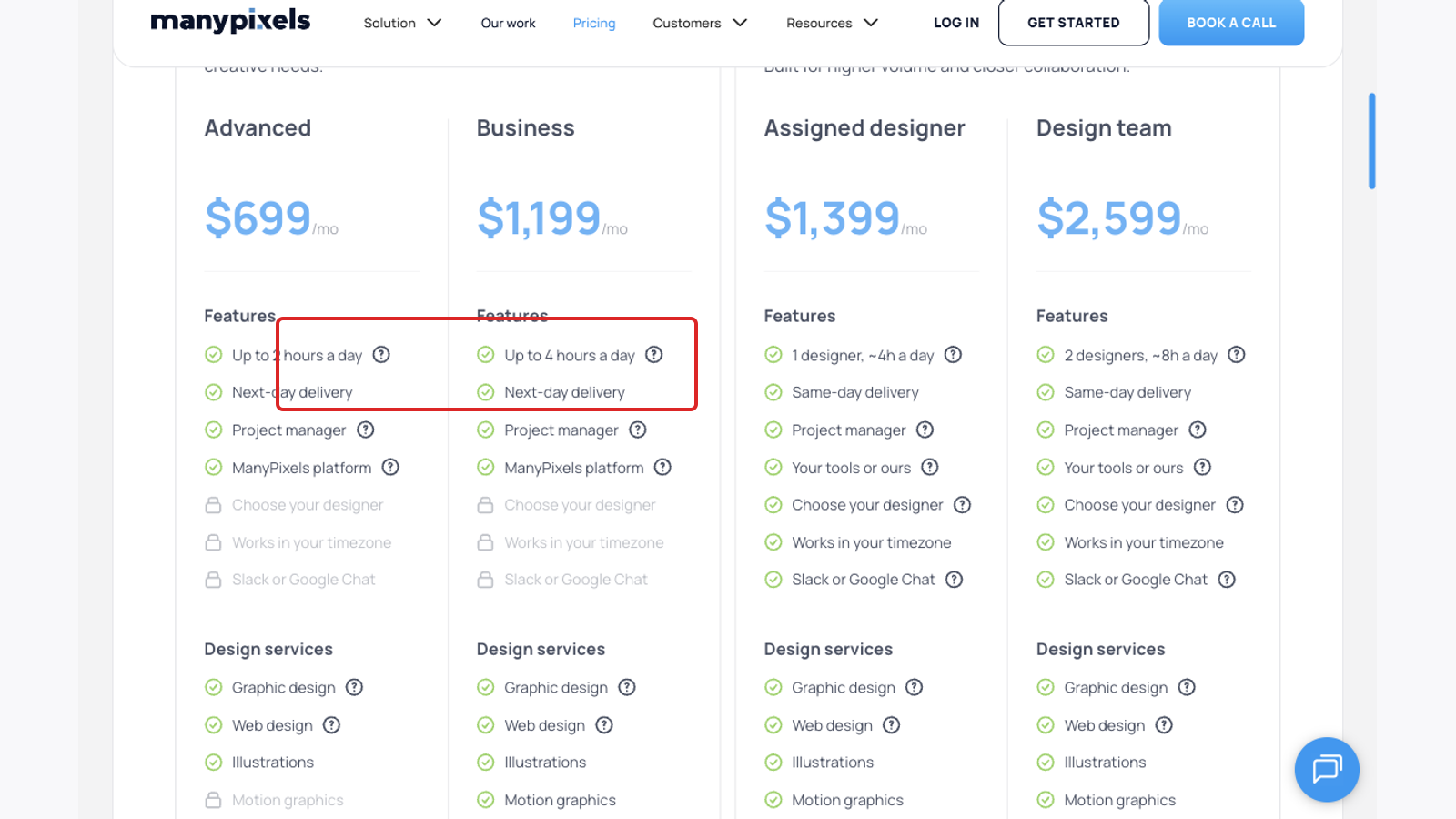
ManyPixels monthly pricing, captured November 16, 2026. Advanced lists up to two daily hours and Business up to four.
Stillmore: Best for social content from business photos
Stillmore suits the owner who needs the next finished piece of promotion from photos already on hand. Stillmore is an advertising creative agency for independent businesses. It starts with existing product, shop, people or brand photos and supplies finished promotional images, short videos and accompanying captions. The team handles the creative planning, production and checks; the business owner publishes the result.
I checked both billing views. Growth displayed $129 per month in Monthly and $99 per month in Annual, while the stated allowance stayed at up to six videos or 36 images. I would compare those amounts only after choosing the billing commitment; the $99 figure is not the month-to-month price.
The current Stillmore pricing page shows Try it at a founding price of $29 per month for one video or six images. Growth is $129 on monthly billing or $99 per month with annual billing, with an allowance of up to six videos or 36 images. Those alternatives share an allowance: they do not mean six videos plus 36 images. Try it is a paid plan; no free production tier is listed on the pricing page. Offers can change, so check the selected billing term and amount before paying.
You choose how involved to remain in each piece. For a specific product launch, you can choose an Inspiration and provide suitable photos. When you want ongoing content without selecting every idea yourself, you can let the team arrange the next creative work after setting up the service and supplying the material it needs. Existing photos can be reused when they remain accurate and suit the next piece. The creative production workflow explains that division of responsibility.
Pros: You can begin with photos already available in the business, and you can delegate ongoing content choices as well as production. That combination is relevant when deciding what to make is part of the workload you want to hand over.
Where it falls short: This is a narrower purchase than Kimp's general design subscription. Do not choose it on the assumption that a social-content allowance also covers packaging files, a website redesign or unlimited bespoke requests. You still need to supply accurate business information and usable photos, and you still need to post the finished content. A product change may require fresh photos even if older ones remain in the library.
For a café owner who has clear menu photos but keeps postponing promotional content, that scope is worth checking. For a marketing team with daily print, web and presentation jobs, I would start with a broader design service. The smaller bill reflects a different amount and type of work, not proof of equivalent agency capacity at a discount.
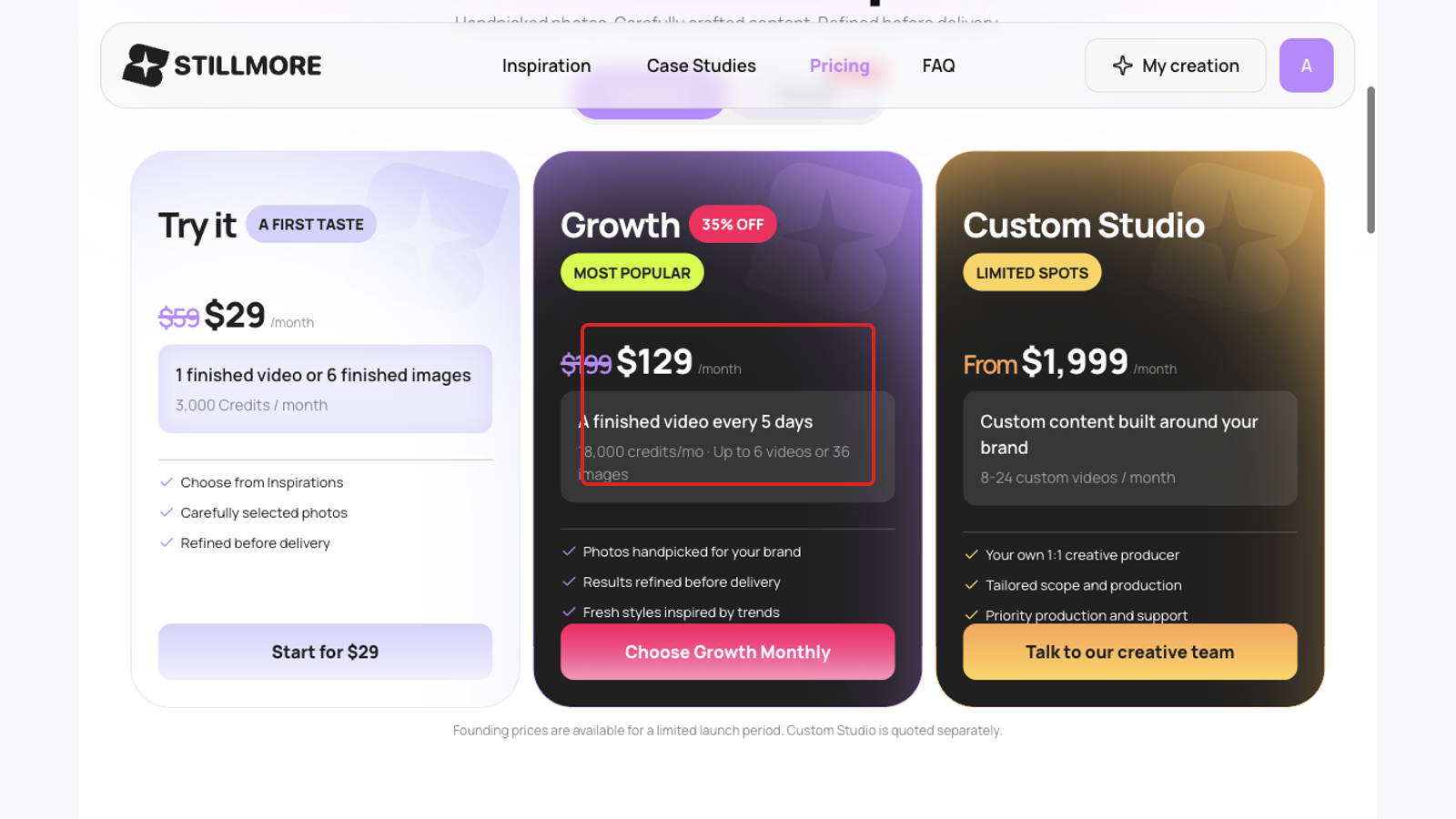
Stillmore monthly pricing, captured November 16, 2026. Growth shows $129 per month and an allowance of up to six videos or 36 images.
Penji: Best for parallel design requests
When two briefs are ready at the same time, the number of active projects deserves a close look. Penji makes concurrent work a visible part of its pricing: Essentials lists two active projects at $995 per month, while Agency Partner lists three at $1,995. That gives a buyer with overlapping requests a useful starting question: which jobs can move together, and who will approve them? Penji advertises a 30-day first-month refund offer on its paid subscription, rather than a free tier.
I opened the explanation beside Short-form Videos & Reels on the pricing page. It described turning ideas, footage and brand assets into short videos, and appeared under Agency Partner. For a video brief, that moved my price comparison to the higher tier. A buyer wanting both ordinary graphics and short-form video should assess the $1,995 plan, rather than assume the $995 Essentials rate covers the same mix.
Essentials advertises one-day turnaround, and Agency Partner advertises same-day turnaround. Those are service claims, not completion speeds established by this test. Penji's request and revision workflow starts with a project form and queue, then lets you leave feedback on a design. A customer still has to explain the intended result and resolve feedback. Several active projects can make that review work more concentrated, even when they reduce the wait for a new task to start.
Consider a business preparing a printed offer and a separate sales presentation. Parallel work may be useful if both briefs are ready and someone can answer questions. If the same owner is still deciding the offer price, the format and the message, additional active slots may sit waiting for decisions. I would bring two representative briefs to a sales discussion and ask how each would move through the chosen plan.
Pros: Active-project limits are stated on the cards, and the higher tier combines a broader production scope with art-direction support. That makes the service worth considering when several defined jobs must move through review together.
Where it falls short: The jump from Essentials to Agency Partner is $1,000 per month. If video is the main reason for upgrading, compare the actual amount of video work you need with a narrower service before committing. Nor does three active projects mean three finished campaigns each day. Complexity, missing inputs and revisions still affect the schedule. The public page can show the commercial structure, but it cannot establish how well the team will interpret your brand.
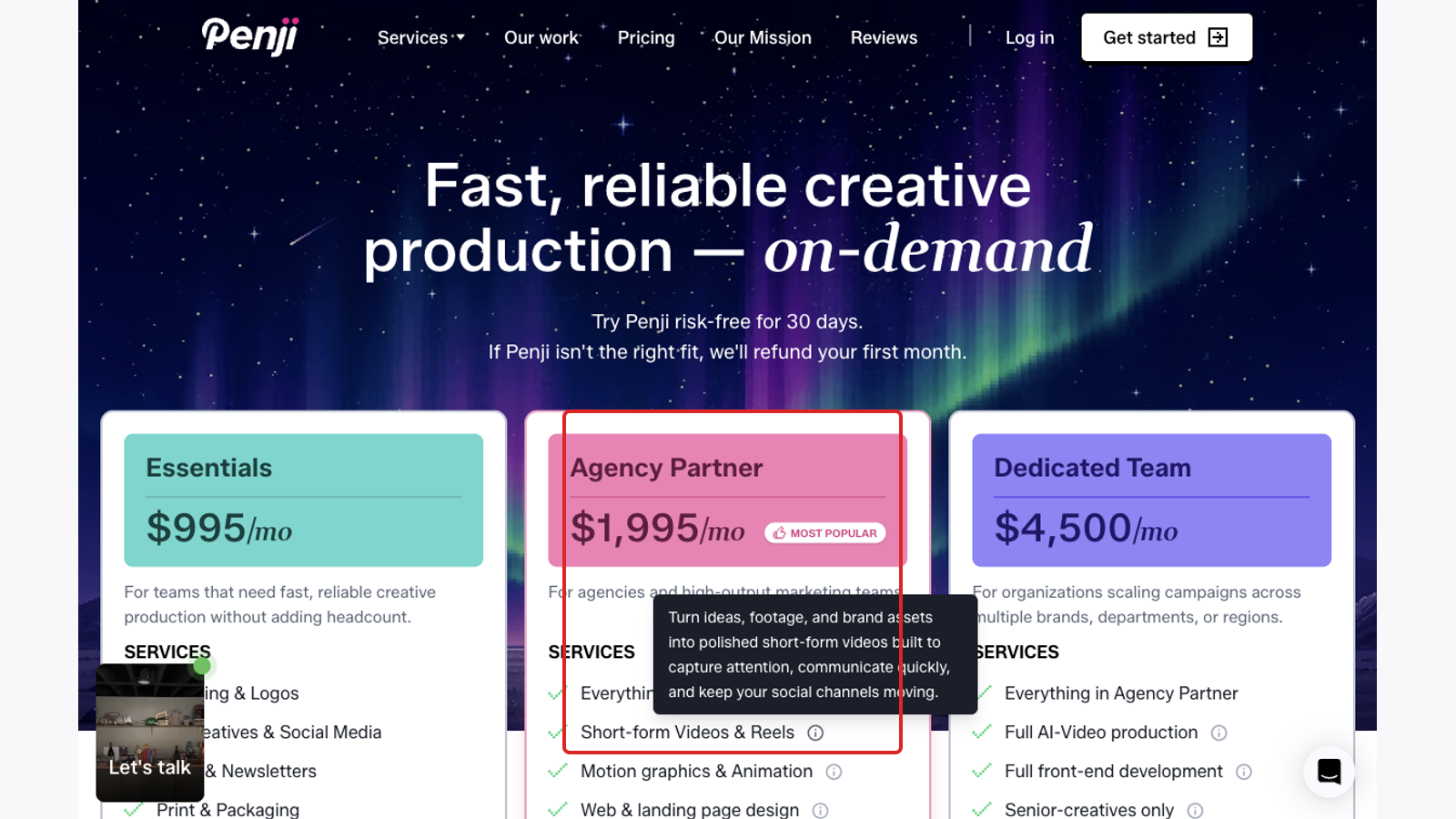
Penji public plan comparison, captured November 16, 2026. Short-form Videos & Reels appears under Agency Partner.
Flocksy: Best for a mixed creative queue
When the same business needs copy, graphics and video, separate subscriptions can become awkward to coordinate. Flocksy groups those disciplines into a subscription priced by daily creative hours. Its two-hour plan is $1,699 a month on monthly billing, or $1,199 per month on annual billing. Its entry monthly price is the highest among these four alternatives. You need enough work across those disciplines to justify it. Flocksy advertises a 14-day money-back offer after paid signup, rather than a free production allowance.
I selected monthly billing on the pricing page and checked the two-Daily-Hours card. It displayed $1,699, compared with the $1,199 monthly equivalent shown for annual billing. The lower headline therefore requires a different commitment; it does not describe the same month-to-month purchase.
Flocksy's daily-hours guidance says projects share a prioritized queue and unused hours can bank for up to 30 calendar days. That may suit uneven production weeks. It does not turn a two-hour daily plan into immediate access to a full production team for an entire day, and a banked balance still needs to fit the service's usage rules.
The management tier matters too. A Production Coordinator is included from four Daily Hours. On monthly billing that four-hour plan is $3,099, compared with $1,699 for two hours. The coordinator's stated role includes managing workflow and helping with priorities. If reducing coordination is why you are leaving Kimp, compare the plan that includes that help, rather than assuming it comes with the lowest price.
For a small marketing team, a hypothetical queue could contain an email graphic, revisions to a sales video and copy for the next promotion. A shared allowance lets the buyer discuss that whole queue with one provider. Before purchasing, I would ask which jobs can progress together and how the hours for revisions appear. A finished-asset count is hard to infer from time alone; a short but intricate motion treatment may use more effort than several straightforward layout changes.
Pros: The service spans multiple creative disciplines, and banked hours offer some flexibility for weeks when the queue is lighter. Published management tiers also make it possible to price the coordination help separately from raw capacity.
Where it falls short: The entry cost is substantial if you only need a few social posts. You still need priorities, timely feedback and usable source material. Flocksy's FAQ also distinguishes website design assets from coding a working website, so a broad creative scope should not be mistaken for every service a business might outsource. Choose it when the mixed queue is real and recurring, not simply because the menu of possible work is long.
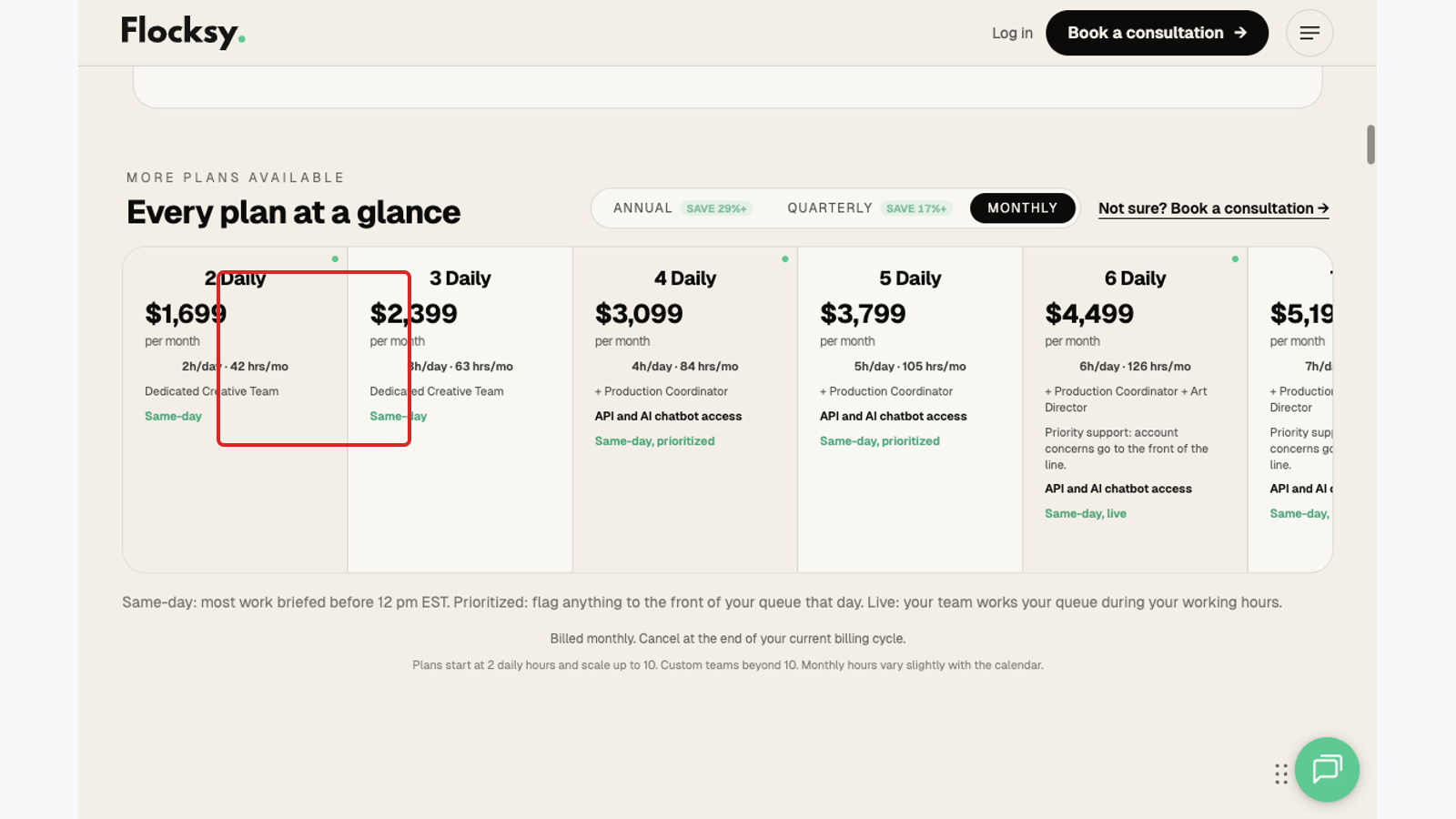
Flocksy monthly pricing, captured November 16, 2026. Two Daily Hours shows $1,699 per month.
How to choose
Write down the work you expected to finish last month but did not. Be specific: four product posts, a revised menu, two short videos, a landing-page layout. Add the source material beside each job. A folder of clear product photos puts you in a different buying position from an unedited interview or a print brief with approved copy.
Next, separate production from decisions. Who picks the subject? Who provides the offer details? Who checks that a price or product claim is correct? Who publishes? If those tasks keep falling back to the owner, a cheaper design queue may leave the original problem intact. If a marketing colleague already owns them, paying for broader creative planning may be unnecessary.
Finally, compare one realistic month against each eligible plan. Use the renewal rate, keep annual commitments separate from month-to-month prices, and ask how revisions consume capacity. A $699 plan that covers your graphic requests can be a better fit than a larger team. A $29 social-content allowance can also be too small if you need several new videos each week. Choose the smallest plan that covers the jobs and turnaround you need.
Conclusion
The right Kimp alternatives solve different problems. I would shortlist ManyPixels for a steady, clearly briefed graphics queue and Stillmore for promotional content made from an independent business's existing photos. Penji deserves a look when concurrent requests matter; Flocksy makes more sense when you have enough mixed creative work to use a daily-hours subscription.
Keep Kimp on the shortlist if its broader service range is already a good match. Before switching, take the same sample month to your chosen provider and check the scope. For the photo-based route, browse content inspiration and compare the examples with the material your business can actually supply.
FAQ
Which Kimp alternative is best for a small business?
Start with the work you need. ManyPixels suits recurring graphics; Stillmore suits promotional content made from existing business photos. Penji is worth comparing for parallel design requests, while Flocksy suits a mixed creative queue. There is no universal winner across those different purchases.
Are there cheaper alternatives to Kimp?
ManyPixels Advanced is $699 monthly, below Kimp Graphics' regular $1,397. Stillmore's $29 Try it plan costs less but buys a much smaller allowance of social content. Compare scope and ongoing prices, not a full design subscription against an introductory offer or a single-video allowance.
Does unlimited design mean unlimited finished work?
No. Unlimited requests usually means you can add work to a queue. Active-project limits, daily hours, complexity and revisions still constrain production. Ask the provider how your actual list of jobs would fit into one month, including the approval time on your side.
Which alternatives include video?
Stillmore supplies promotional videos from suitable photos. Penji lists short-form video on Agency Partner, and Flocksy includes video editing within its creative service. Kimp has a dedicated Video plan. Check the specific brief and plan instead of treating every kind of video as interchangeable.
Will these services publish social posts for me?
Do not assume production includes account management. Stillmore delivers images or videos with captions, and the business publishes them. For any provider, ask explicitly about scheduling, account access, comments and reporting if those are part of the job you want to delegate.
What should I prepare before switching from Kimp?
Gather brand files, source photos or footage, approved copy, recurring formats and examples of work you want to continue. Write down current deadlines and unfinished requests. Then ask the new provider about scope, ownership, revisions and capacity before moving a live campaign or cancelling existing support.

About the author
Maya Brooks
I'm Maya Brooks, and I write about content strategy and social media planning for small businesses. Most of what I cover starts with a simple question: what should this piece of content help a customer understand or do? My work here covers content calendars, creative briefs, campaign messaging, and repurposing the photos and clips a business already has. The practical problem is usually not a shortage of ideas but deciding which ones fit and how often to publish them without the routine collapsing. I keep one rule: when I describe a workflow, I say which parts I have run myself and which parts I am summarising from documentation or a business owner's account. You should be able to tell the difference on the page.
Give them a reasonto stop by.
Send us your phone photos. Get posts ready to share.
See what we can make
Keep exploring
All stories ↗- Social media
What Is Evergreen Content? Examples for Small Businesses
Evergreen content is information that stays useful long after you publish it because people keep coming back with the same question. To find a subject for your shop, listen for a decision each new customer has to make, such as whether a mug handle will fit their grip. A side view and an in-hand photo can answer that question as long as they show the shape you still sell. Check price tags, links and product changes before sharing an older post. A pottery shop could give its mug photos to Stillmore for a finished image or short video with a caption. The owner confirms the product details and chooses when and where to publish.
- Social media
100 Pound Social Review (2026): How It Manages Your Posts
The £125 Basic plan buys 12 original posts and publishing across two profiles. A second profile does not double the number of ideas. See how the monthly batch works, what two short videos add to the bill, and when a small business would be better served by buying creative or scheduling posts itself.
- Social media
Stillmore vs Feedbird: Who Makes the Post and Who Publishes It?
Stillmore makes content for a shop that wants to do its own posting, while Feedbird can make the posts and publish them for you. A ceramics shop can give Stillmore photos of a new mug and receive a finished image or video with a caption, ready to share when the pieces go on sale. You can pick the visual style yourself or leave that choice to the team once your photo library meets your plan's requirements. With Feedbird, someone at the shop still needs to approve the work and connect the account where it should appear. To compare costs, ask both companies to price the same mix of images and videos, then check the billing period and who will handle posting.