



3 Best Penji Alternatives for a Small Shop in 2026
SUMMARY
For a candle launch, I compare Penji’s $995 monthly plan for two active projects with ManyPixels’ $699 monthly plan for print jobs that can take turns. Kimp covers print and footage edits together, while Stillmore turns existing product photos into posts for the weeks after launch.
Contents

I have three photos of a new candle, a clip of someone trimming the wick and the printer’s dimensions for a shelf card. The scent name is approved. A promotional flyer needs artwork, too. That gives me two print jobs to keep moving before launch, but once the candle is on the shelf, I still need something to post next week.
Of the Penji alternatives I’d consider, ManyPixels suits a shop with a steady queue of print requests. Kimp makes sense when someone regularly shoots footage that needs editing alongside the graphics. Stillmore, which publishes this guide and is one of the services compared here, takes on recurring social posts made from product photos. There’s also a good reason to keep Penji when both print jobs need attention at once.
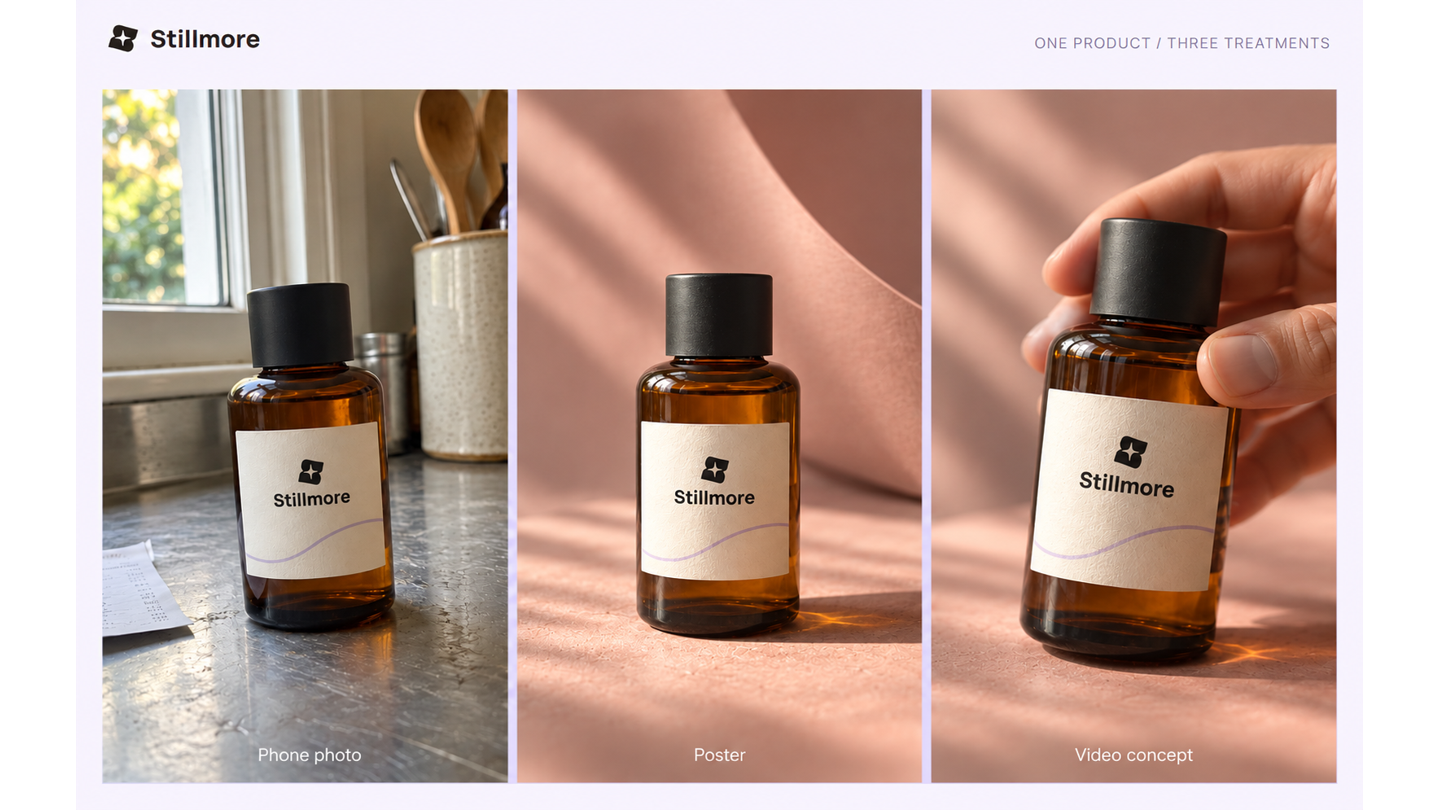
Stillmore’s published workflow illustrates three treatments of the same bottle.
What Is Penji?
Penji is a design subscription. Its Essentials plan includes print design, packaging and ad creative for $995 per month on monthly billing, with two projects active at once. I can give the shelf card and flyer separate briefs and keep both in progress. That matters if the printer asks for a change to the card while a colleague is reviewing the flyer. Penji’s plan details
The decision changes when I add footage. Penji lists short-form video and motion graphics on Agency Partner, which costs $1,995 per month on monthly billing and supports three active projects. Before moving up a tier, I look for the next clip on the shop calendar. Paying for editing every month makes more sense when someone has a reason to keep filming.
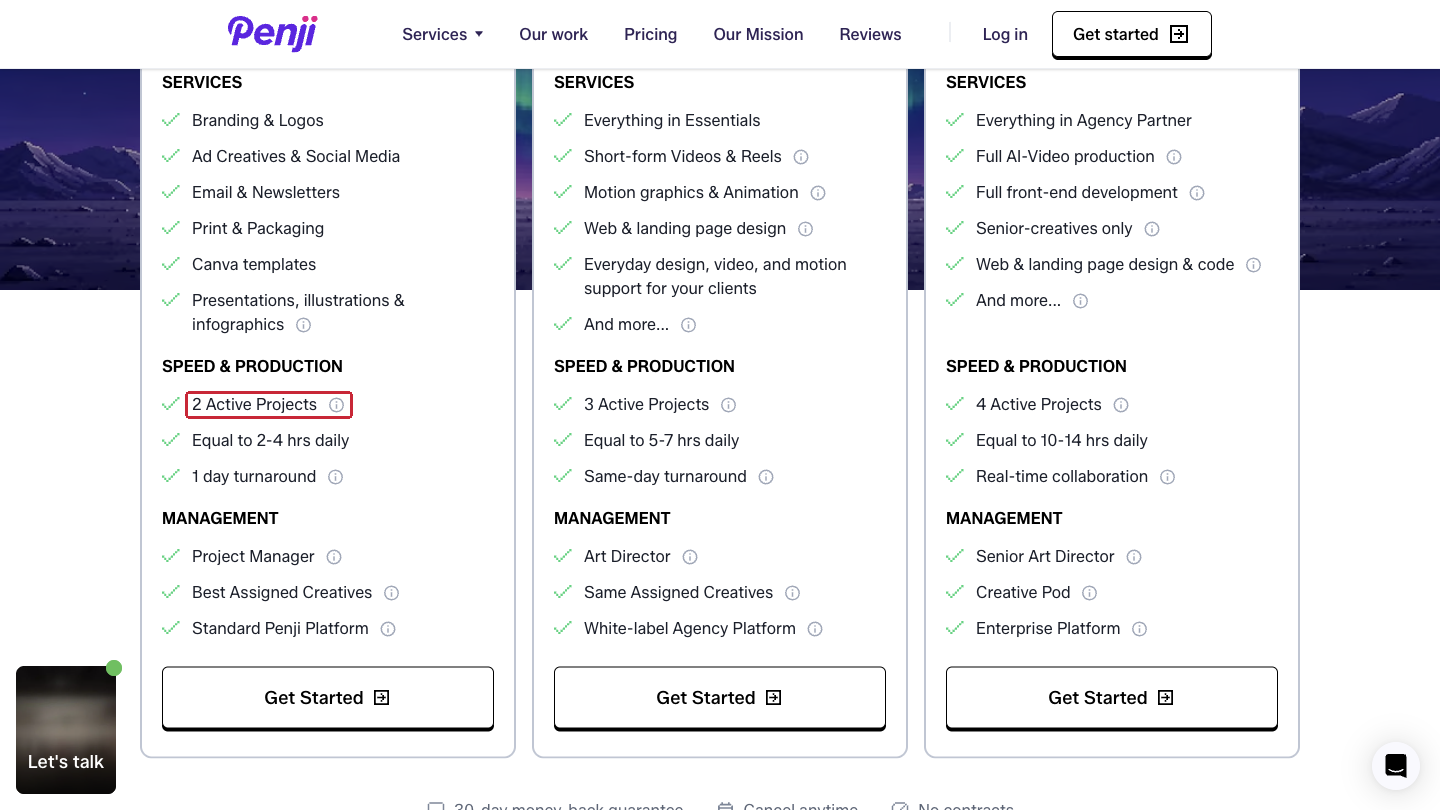
Penji lists two active projects on Essentials.
The Penji Alternatives at a Glance
These are the providers’ published US dollar prices as of November 20, 2026. I use Kimp’s regular monthly rate. The capacity column shows what the named plan allocates, which matters when two jobs land on the same morning.
| Service | Launch job | Plan and monthly price | Published capacity or scope | What the shop supplies or decides |
|---|---|---|---|---|
| Penji (baseline) | Shelf card and flyer | Essentials, $995 billed monthly | Two active projects | Print specs and copy for each brief |
| ManyPixels | Shelf card followed by flyer | Advanced, $699 billed monthly | Up to two design hours a day | Which job goes first and what needs revising |
| Kimp | Print artwork and a wick-trimming edit | Graphics + Video, $1,295 per month, regular rate | Graphic design and video editing | Source footage, cut instructions and print requirements |
| Stillmore | Social posts featuring the jar | Try it, $29 billed monthly | 3,000 monthly credits, enough for one video or six images | Product photos, accurate details and when to publish |
How I Tested
I take three briefs to each provider’s published plan page. For the print brief, I need artwork my printer can use for a shelf card, with a flyer waiting behind it. For the edit, I want a viewer to see the scissors reach the wick before the care instruction appears. For the social brief, all I have next week are the same three photos and a product name. I check which brief the subscription covers and which decisions still fall to me.
Then I change one condition. Suppose the printer needs its file while the flyer is still in review. An active project slot is useful in that situation. A daily design allowance tells me how much attention the queue can receive. Credits tell me what I can commission from my photos. None of those figures gives me the date a particular file will be ready, so I keep the printer’s cutoff in the brief.
Three Penji Alternatives for a Shop Launch
ManyPixels — Best for a Print Design Queue
The shelf card gets the first spot in my ManyPixels queue because the printer needs it before the shop needs the flyer. Advanced costs $699 per month on monthly billing and provides up to two hours of design work a day. ManyPixels says that usually means one task in progress, although small requests or revisions can share a day. That gives me a practical way to decide whether the plan fits. I can name tomorrow’s priority without having to guess how many flyers a designer can finish in a month. ManyPixels pricing
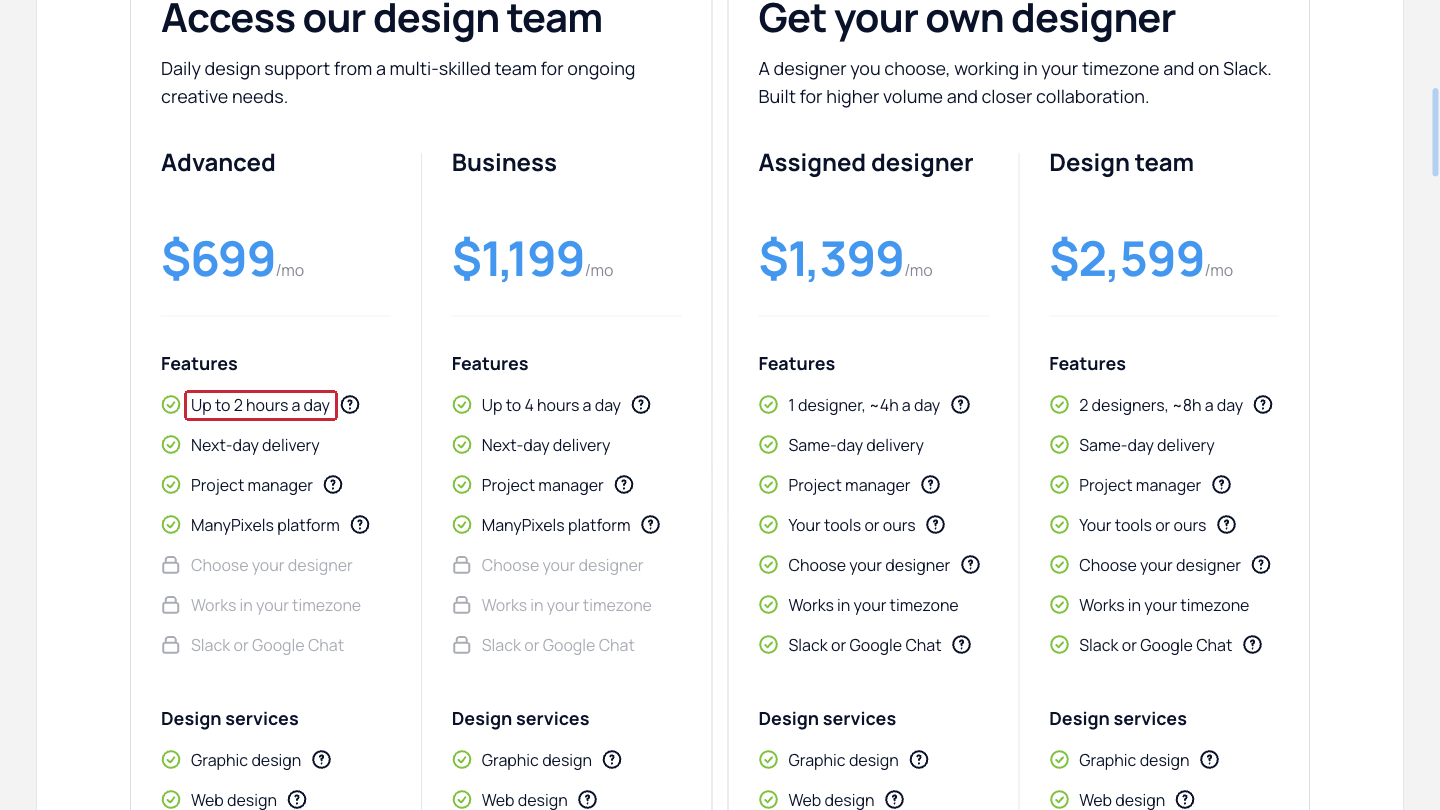
ManyPixels measures Advanced capacity in daily design hours.
For the card, I attach the printer’s dimensions, the approved scent name and the label artwork. I mark the background as running to the edge and include the bleed measurement the printer requests. Extending the background beyond the intended cut gives the printer a margin when trimming the card. That small detail belongs in the initial request, especially if someone else will review the proof while I’m at the counter. Adobe’s guide to print bleed
ManyPixels keeps requests and feedback on its platform and includes a project manager and quality control. I can put the corrected scent spelling on the card request and leave a different instruction on the flyer, where there’s room for a longer description. I still supply the wording and tell the team which correction takes priority. That division suits a shop with someone who already handles printer proofs. On the morning the card goes to press, that person can sign off on the spelling before moving the flyer up the list.
Where It Falls Short. Two substantial jobs compete for the same daily hours. If the flyer needs a new layout while the shelf card is due back at the printer, I have to decide which one waits. For a shop that faces that choice every week, Penji Essentials’ two active projects may justify its higher monthly price.
Kimp — Best for a Launch With Graphics and Video
The moment I want to use the actual wick-trimming shot, my brief changes. I have footage worth preserving and a specific edit in mind. Kimp’s Graphics + Video plan combines graphic design and video work for a regular $1,295 per month. Graphics alone lists at $995 per month. I’d put the combined plan on the shortlist for a shop that routinely films demonstrations and still needs printed material for the counter. Kimp pricing
For the print request, I give the designer the card dimensions, exact scent name and the printer’s file requirements. For the edit, I identify the moment the scissors close, ask to keep that action visible, and supply the words “Trim the wick before lighting” for the overlay. I circle the scent name on the shelf-card proof and ask the editor to match its spelling and capitalization in the closing frame. The instructions need to be different because a shopper standing beside the jar already has context that someone watching a close-up on a phone may lack.
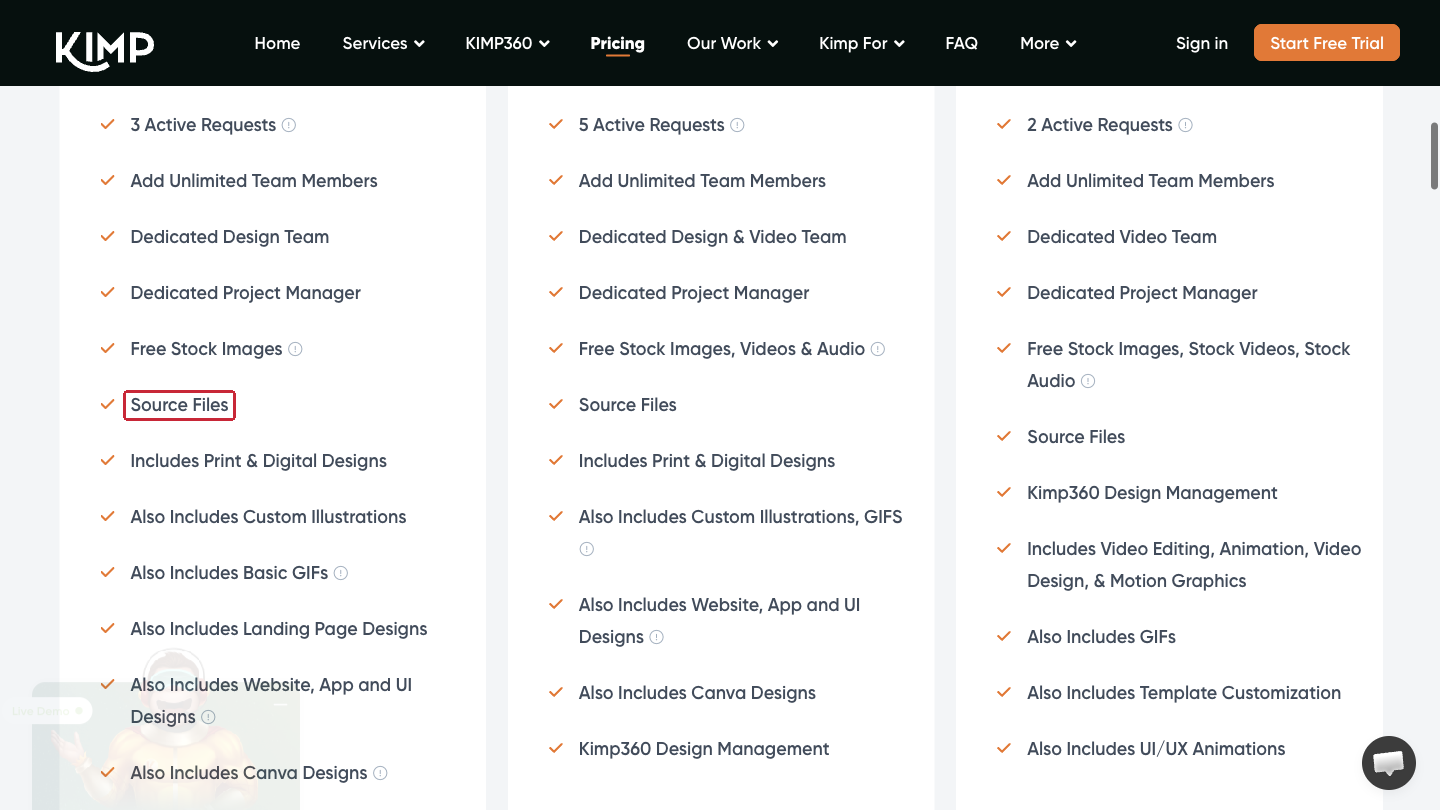
Kimp lists source files among its design plan features.
Kimp includes a project manager and editable source files. I care about those files when I picture the next scent arriving in the same size jar. I can ask for the editable card artwork at handoff and give a future designer the layout with the old name clearly identified. For the video, my responsibility starts earlier. Someone at the shop needs to capture the action clearly enough for an editor to work with it. I check the frame for the wick tip before putting the scissors away.
Where It Falls Short. The combined rate is a recurring cost even when the shop has nothing new to edit. I look at the next two launches and ask who is filming them. When the only footage on hand is this one demonstration, I price the print work on its own before committing to a mixed subscription. Shops already weighing that service can also compare Kimp alternatives.
Stillmore — Best for Posts From Existing Product Photos
A week after launch, the card can stay on the shelf. The three photos still give me something to say about the candle. I choose the front view for the scent announcement because the label is readable, and keep the close-up for a later post about the jar. I want people to know they can stop by the shop to smell the new candle, so I include that invitation with the jar photo. I leave the crop and lettering to Stillmore’s team, along with the wording of the caption.
I give the team the exact scent name and point out which photo shows the current label. For the announcement, I can pick a creative direction from the examples. For follow-up posts, I can add the photos to the library, enable automatic creation and let the team choose suitable material and arrange the work. The team checks details such as product appearance and text before delivery. I decide when the finished piece goes on the shop’s account, so I can hold the announcement until the new jars are actually on the shelf. The Stillmore creative workflow shows the steps using an amber bottle as its example.
The Try it plan costs $29 billed monthly and comes with 3,000 credits a month. The published allowance buys one video or six images. For a month in which I want three separate still-image posts, I would budget for images. Spending the allowance on a single video leaves a different calendar to fill. That calculation is more useful to me than comparing credits with designer hours. Stillmore pricing
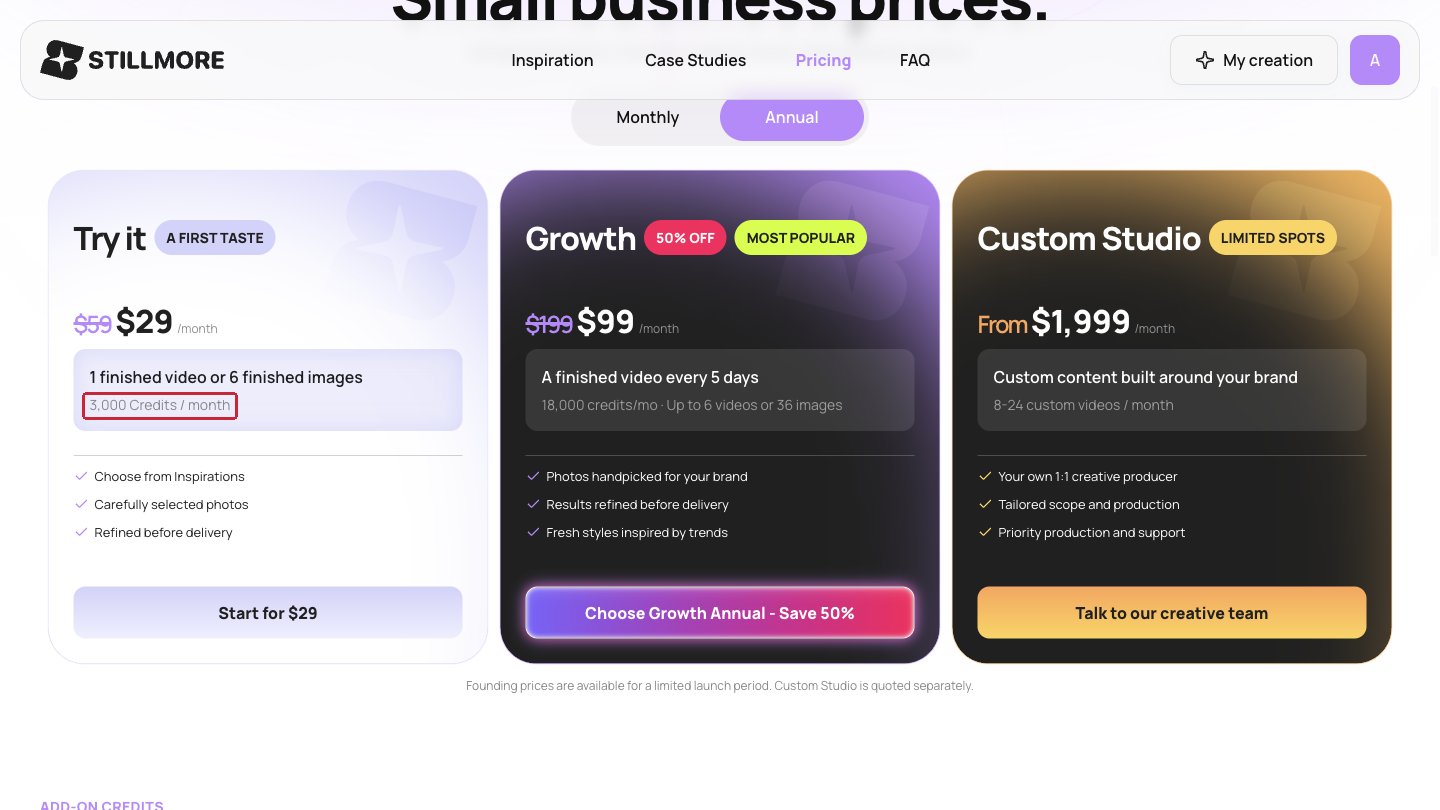
The Try it plan includes 3,000 credits per month.
Where It Falls Short. I still need a designer for the shelf card and flyer. I’d also choose a footage-editing service when the brief requires that exact shot of the scissors. Stillmore fits the part of my calendar where photographs are the assets I can reliably supply, the team handles production and captions, and I have time to publish.
How to Choose
I start with the next printer booking. When the card and flyer both need active revisions most weeks, I’d keep Penji Essentials. When one can wait its turn and someone in the shop can keep the briefs in order, I’d pick ManyPixels Advanced. Both decisions depend on who is available to approve the proof before the printer closes.
For regular footage edits alongside print, I’d compare Kimp’s $1,295 Graphics + Video plan with Penji’s $1,995 Agency Partner plan using an actual upcoming brief. I’d include the length of the source clip, the edit I want and the date the artwork goes to print. When filming ends after launch but I keep taking jar photos, I’d separate the social posts from that print decision.
Conclusion
The shelf card may change once a season. The empty spot in next week’s posting calendar comes back every week. I’d keep Penji for overlapping print briefs, use ManyPixels for a queue I can prioritize, or choose Kimp when footage editing recurs alongside design. Stillmore makes sense for the shop that already has photos and wants someone else to turn them into finished posts.
Frequently Asked Questions
How much does Penji cost for print and short-form video?
Penji Essentials includes print and packaging design at $995 per month on monthly billing. Agency Partner adds short-form video and motion graphics at $1,995 per month on monthly billing. It also raises the active project count from two to three.
How do Penji and ManyPixels handle two requests at once?
Penji Essentials allows two active projects. ManyPixels Advanced provides up to two design hours a day, usually on one task at a time. Small revisions can share a day, so tell the team which request has the earlier cutoff.
What does unlimited design mean for a launch deadline?
You can keep adding requests, but the queue still takes time to work through. Share the printer’s cutoff, identify the first file you need and ask the service to confirm timing for that specific brief.
Which Kimp plan covers printed cards and edited footage?
Kimp Graphics + Video covers both kinds of work for a regular $1,295 per month. Give the designer your printer’s specifications and give the editor the original clip with directions for the cut.
Can I use product photos for social posts and get captions?
Yes. Stillmore takes existing product photos and delivers social images or videos with captions. You can choose the direction yourself or enable automatic creation for ongoing work. You publish the finished pieces on your own accounts.
When is it worth keeping Penji?
Keep Essentials when two print or design projects regularly need attention at the same time. A shelf card awaiting a printer correction and a flyer in layout give both active project slots a purpose.
About the author
Maya Brooks
I'm Maya Brooks, and I write about content strategy and social media planning for small businesses. Most of what I cover starts with a simple question: what should this piece of content help a customer understand or do? My work here covers content calendars, creative briefs, campaign messaging, and repurposing the photos and clips a business already has. The practical problem is usually not a shortage of ideas but deciding which ones fit and how often to publish them without the routine collapsing. I keep one rule: when I describe a workflow, I say which parts I have run myself and which parts I am summarising from documentation or a business owner's account. You should be able to tell the difference on the page.
Give them a reasonto stop by.
Send us your phone photos. Get posts ready to share.
See what we can make
Keep exploring
All stories ↗- Social media
4 Best Kimp Alternatives for Small Businesses (2026)
Compare ManyPixels, Stillmore, Penji and Flocksy with Kimp by price, scope and owner workload. See which service fits recurring graphics, photo-based social content or a mixed creative queue.
- Social media
Stillmore vs Vidpros: Photos vs Video Editing (2026)
Written for small business owners and lean teams deciding how to outsource ongoing social content, this guide compares Stillmore and Vidpros using official plan terms verified on November 18, 2026. It breaks down how photo-first image and short-video production starting at $29/month compares with raw-footage video editing subscriptions starting at $1,000/month across eight dimensions, pricing economics, pros and cons, scenario verdicts, and six FAQs.
- How it works
Inside Stillmore: Our Creative Production Workflow
Your phone can hold plenty of useful photos while your next promotion still needs work. This article takes you inside Stillmore's creative process: shaping a visual direction, producing images and videos, and checking the details before delivery. Meet the professional craft behind the work, see how the team chooses production tools for your product and delivers finished marketing content, and learn what stays in your hands when you choose content or leave ongoing creation to the team.