



5 Coffee Subscription Promotion Ideas for Small Roasters
SUMMARY
A café regular who wants the house coffee at home needs a different invitation from someone buying a gift. Match five subscription offers to the photos you already have, borrow a caption for your own plan, and trace the response from the counter or social post to a paid order.
Sofia Bennett
Contents

A regular puts down her empty cup and asks, “Can I get these beans at home?” You can point her to a subscription if the bag in the post matches what you served her. Across the counter, a gift buyer has a different question. Will her brother get three bags at once or one bag a month? The same photo of a latte leaves both of them guessing. These five coffee subscription promotion ideas pair a photo you may already have with an offer a customer can recognize and buy.
Choose a promotion that matches the coffee plan
Pull up the subscription page on your phone. Pick the exact plan you want to sell and follow it as far as the payment screen. Write down the bag weight, the first charge, how often another payment is due, and whether postage is included. A fixed-term gift needs a different line of copy from a recurring order, even when both ship in the same box. Use the question you hear most often to choose your first post.
| If the customer asks… | Start with this promotion | Photo to use |
|---|---|---|
| What comes in the first shipment? | Open the first box | The contents of one actual shipment |
| Can I get the coffee you served me? | Take the café blend home | The cup beside its matching bag |
| Will I get to try another coffee? | Preview the next roast | The incoming bag and its tasting card |
| How often will I need more? | Work out a refill interval | The bag on a scale beside a brewer |
| Can I give someone three months? | Put the gift schedule on a card | A bag beside a handwritten gift note |
Decide what the offer can cost
A cup of the featured coffee can give a regular a reason to subscribe at full price. If you do include a sampler, put it on the packing scale with the order and check the postage for that weight. In a worked example, a first shipment priced at $22 with $14 in coffee, packing and delivery costs leaves $8 before fees, labor and overhead. A $4 introductory discount cuts that to $4 before those same expenses. Budget the incentive from the first shipment on its own. You’ll know what the second delivery earned only after the customer pays for it. For a free-sample offer, write the regular renewal price beside the first-box price and check the second shipment in your order system. A handwritten tasting card might make more sense if postage jumps when you add a sample bag.
Show what arrives in the box
Open one mailer and show it just as the person packing orders would send it to a new subscriber. In a two-bag plan, turn both labels toward the camera and leave the tissue paper tucked under the bags. Someone scrolling should be able to count what they’re buying. Open the post on the whole box. In the next frame, move close enough to read the names. A sample caption for a monthly plan is “Two 250 g bags in your first delivery. Open the House Blend first if you like chocolate notes.”
Counter Culture’s Blend Box specifies two 12-ounce bags per shipment. Its coffee team picks two blends every two weeks, and customers choose their delivery frequency separately. Maybe you change your selection every Friday and one of your subscribers gets a monthly box. Say which Friday’s picks go in that box. A photo of four different bags under “This month’s coffees” could reasonably look like a four-bag order.
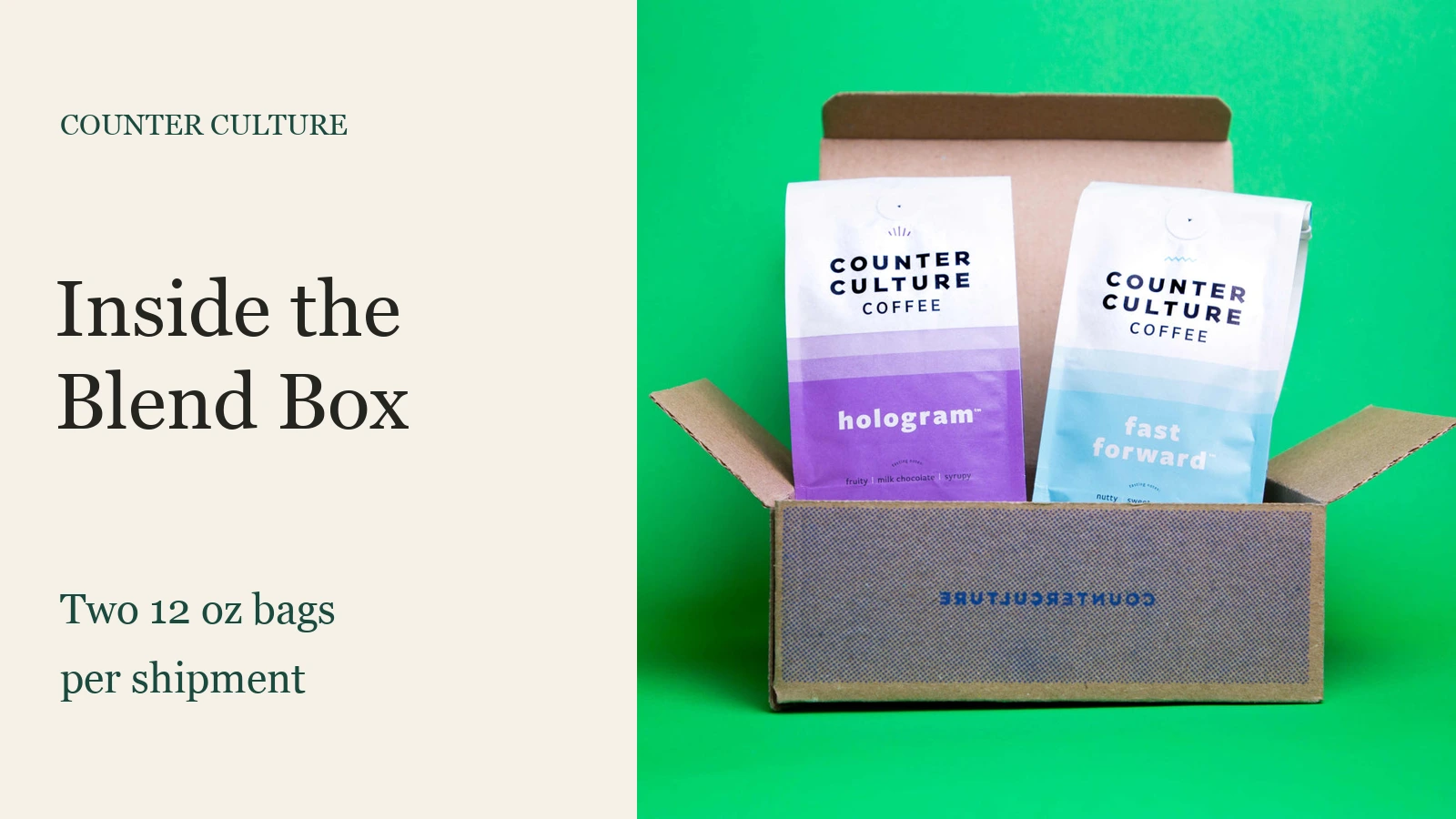 The two bags fit side by side, so a new subscriber can see the contents of one box.
Make the bag name legible
Enlarge the photo on your phone and look for the smallest word that distinguishes one coffee from another. If a crease hides “Decaf,” pick another frame. If all the existing shots have glare, this guide shows how to photograph a shiny product label with the packaging you have. Check the post again at normal size. If the label is still hard to read, put its exact name in a short line under the picture.
Let café regulars take the batch brew home
A retail shelf shot asks a regular to remember which bag the barista used. Start with a picture of the cup beside the bag you’re brewing that day. At the till, a small card can say, “Liked today’s filter? Brew our Market Blend at home. Scan for the bean subscription.” Print a code that opens that blend’s plan directly. Put the same wording on your café account while the batch is on. If your café rotates the filter every morning, leave a fresh card for the opening barista. Where pickup is an option, put the collection day on the card and show a bag at the pickup shelf. A picture of a parcel on a doorstep would promise a different service to someone scanning the card.
For a vertical post, keep the cup rim and the name on the bag in the opening frame. You can crop a landscape product photo for Reels to check whether both survive the narrower frame. If the crop cuts off the label, start with the cup and follow with a close-up of the bag. End on the choice someone actually has to make at checkout, such as whole bean or filter grind, if you offer both.
Preview the next roast in a rotating plan
For a subscription that changes coffees, use the incoming roast as the reason to join this shipment. Try a close-up of the new bag beside its tasting card. For a confirmed selection, you could write, “Look for red apple in our next filter coffee, a washed Colombian. Order by Thursday and we’ll put a bag aside for you.” Give the cutoff a calendar date and time before posting. If the selection can sell out before then, change the caption and the order page as soon as the packing list closes.
Keep the previous month’s image if it explains the rotation. Mark it “Last shipment” directly on the photo and put the upcoming bag first. A returning customer may recognize the old package while a newcomer learns which one they can still order. If you haven't chosen the next coffee yet, identify the pictured bag as a past selection and invite readers to join the rotation. That lets you keep taking subscriptions while the new lot is still on the cupping table.
Help a household choose its refill interval
Help customers who worry about beans piling up. A 300 g bag lasts 15 brews at 20 g each. For someone making one such brew every morning, a delivery every two weeks would arrive with one brew left in the bag. Write the dose in the caption so someone sharing a larger pot can redo the calculation. If the plan only ships monthly, send that reader to a larger bag you actually sell or suggest a one-off order to measure how long it lasts.
Give gift buyers a date to put on the card
With a prepaid gift, the buyer may need something to hand over before the coffee arrives. A photo of a bag beside a handwritten note gives them an idea of what to write. For a hypothetical three-delivery offer, a buyer might write, “Your first bag ships March 3. Another follows in April and May. Love, Jo.” Use a shipping date only if you can honor it. If you sell a redeemable gift instead, show the recipient where to enter the code and explain who chooses the first shipment date.
Stumptown’s gift guide lets shoppers choose three, six or twelve months. For a small shop offering one term, the image can carry just that choice. Put the total due today next to the number of deliveries and say whether it renews. Check when any gift email goes out, too. For someone organizing a birthday surprise, an email sent the moment the order goes through could spoil the surprise. If someone buys the gift in person, give staff a slip with those details for the envelope. A recipient who opens a card on Sunday can then tell when to expect the first bag, even while the café is closed.
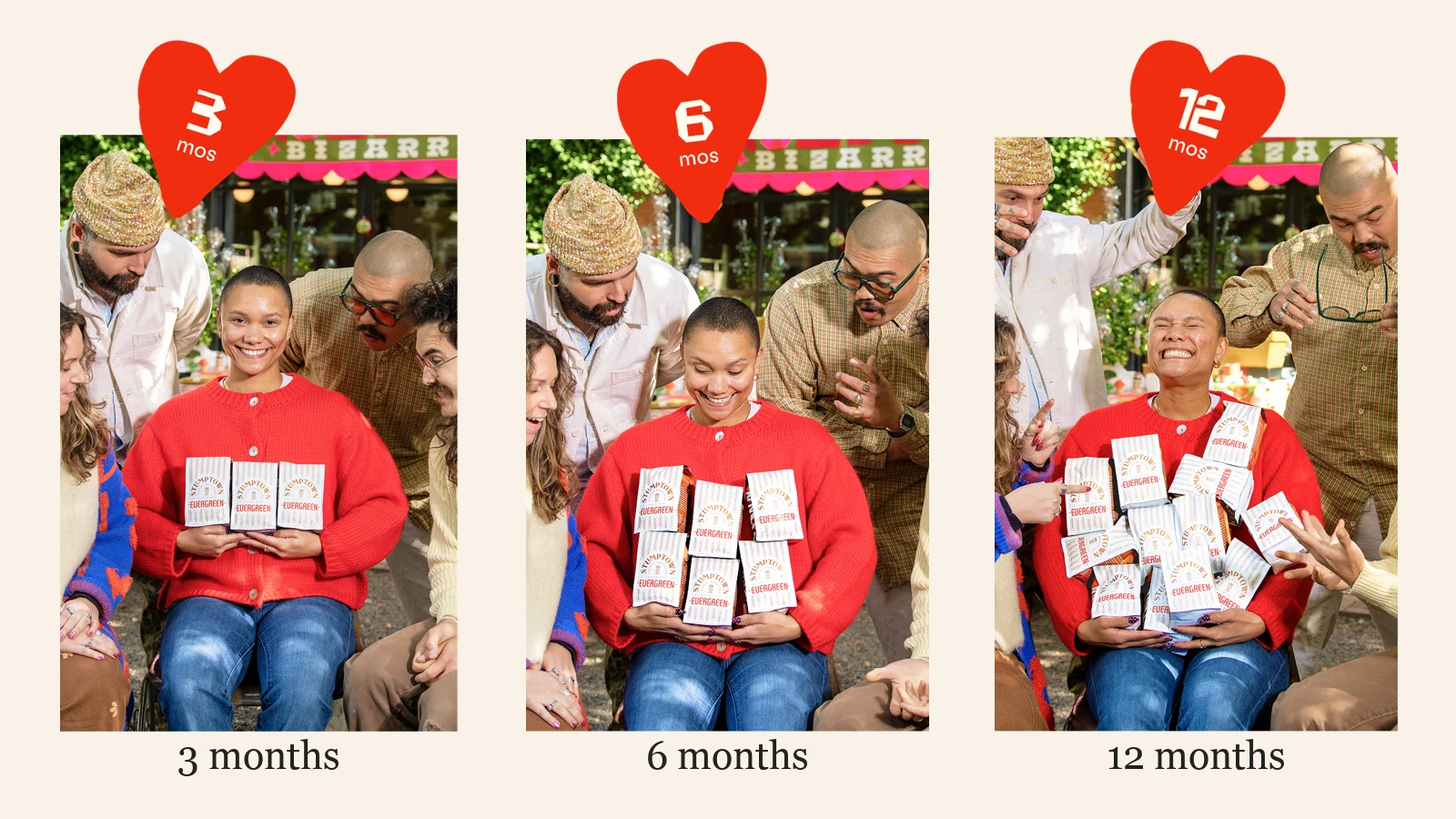 Stumptown uses the number of months to distinguish its prepaid gift options.
Choose the first post and check what it sells
If you have a clear bag photo and a short caption, you can publish the first post yourself. For a sequence with several photos, Stillmore can use your existing pictures to make a finished video or image and supply the caption. Send the team the exact coffee name, the frame that should open the post and the link to the matching offer. Check the coffee details in the finished post, then publish it on your own account. For a visual reference to send with the photos, browse the food and drink inspiration and pick one treatment that leaves room for the label.
Give the counter card and the social post different tracking links to the same plan. After one ordering window, record visits and paid first orders for each link. For example, a counter card might bring 12 visits and two paid subscriptions. Log both numbers, then ask the barista what questions came up at the till. Repeated questions about pickup might justify adding the pickup day to the card. Check the next billing cycle separately to see how many of those new subscribers paid for another delivery.
Coffee subscription promotion FAQ
Can a promotion work with only one coffee photo?
Use a single bag image for a refill post. Put the bag weight and the shipment interval in the caption, then link to the plan pictured. Save the unboxing idea for when you can show the contents together.
Why does our counter QR code sell just one bag?
Scan the card and add the blend to your cart. If it says “one-time purchase,” print a card with a QR code for the recurring plan. Scan your replacement and check that the cart shows how often the beans ship.
Should a café offer a first-bag discount?
Consider it if the first shipment covers the discount and its costs. For regulars already asking which coffee you brew, start with a counter card naming that blend. You can test a discount later against the same offer.

About the author
Sofia Bennett
I'm Sofia Bennett, and I write about video production and visual storytelling for small teams: planning a short video, choosing useful source photos, sequencing shots, pacing, and captions that people can actually read. My interest is in the decisions that are invisible when they are right and obvious when they are wrong. What belongs in the opening? Where does a sequence lose clarity? Which detail needs another look before publishing? Any example I use comes from a real project or is constructed to make a single point, and I say which. When a walkthrough only works because of a good source photo, I point that out rather than letting the result look easier than it is.
Give them a reasonto stop by.
Send us your phone photos. Get posts ready to share.
See what we can make
Keep exploring
All stories ↗- Social media
Restaurant Holiday Promotion Ideas to Make With Stillmore
Restaurant holiday promotion ideas for independent owners with food photos and little time to make content. Choose from five practical formats, adapt a complete fictional pickup-post example, and plan an announcement, cutoff reminder and sold-out message. Includes photo checks, caption templates and one clear customer action for each promotion.
- Social media
7 Custom Cake Advertising Ideas From Your Photos
Use the cake photos already on your phone to show what a customer can order. Seven post ideas pair a specific picture with a caption that asks for the date, servings, design, and pickup details you need for a quote.